
Introduction
Change Key Message. Communication is the Great Enabler of Change and it can accelerate and support all change programs end-to-end. However, the motivation to change has to be captured in a key message which will then have to be cascaded throughout the organisation in ways and means that touches the hearts and minds of the people. This is important because if the people do not hear the reason for the change, they will also not feel the need for the change.
Role of Communication Departments. Ideally the internal or corporate communication departments in your organisation could be helping you to organise the change communication activities for you, starting with the development of the change key messages. However, in real life, most communication departments are stretched and do not have the time nor the resources to support change programs. As such this important task is often delegated to the change manager or others who may not have the best experience or expertise in communication.
5 Best Practices to Roll-out Change Communication. You cannot assume that a change manager will also be an expert in communication, anymore than that you can expect a communication manager to be an expert in change management. If you do not have a strong background in communication but you need to roll-out a change communication plan for your organisation, the following five basic best practices can be a good starting point. And you would probably still need to hire a communication expert to support you.
#1. Make it Consistent
How: Use a “Message House” template to keep your messages aligned

Change Key Message. A change key message is the most important message that you would like to communicate to the audience that you are trying to change. It should be a simple and short sentence with carefully chosen words that precisely conveys what you want to say. As much as it sounds easy, I have often seen managers struggling to write down a key message. However with coaching and practice, it can become a timeless asset for a manager.
Offer of a benefit in the Change Key Message. Organisations implement changes due to organisational needs, business process improvemens, digital transformations, company core values etc. It is clear that these organisational goals will improve the company’s business in terms of operational efficiencies, better employee engagement, better profits, better customer satisfactions, sustainability etc. But please keep in mind to try to explain these in terms of an ultimate benefit for the people going through the change. This connection between the change and the benefit to the people will make it easier for the message to be accepted, understood and supported.
Message House Template. The overarching change key message could be written at the top of a message house template as shown below. This template can then be distributed to managers in a workshop session and they can be coached on how to localise these messages for their own departments. In this way, all the localised versions of the main change key message will remain structured, aligned and consistent.
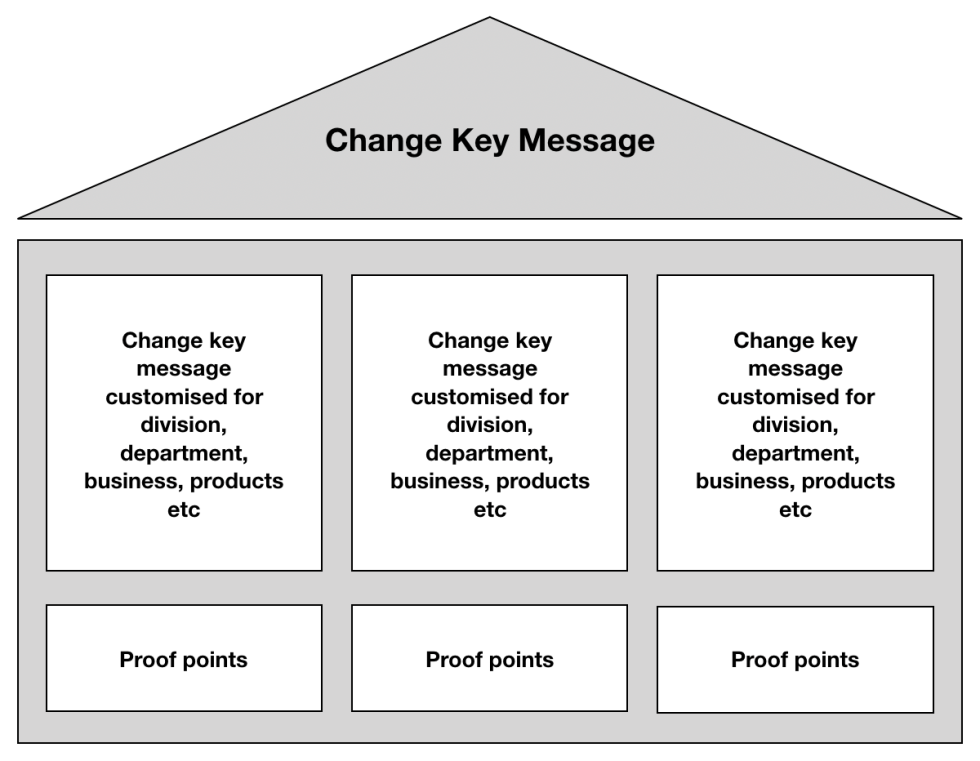
Proof Points. Proof points are simply qualifying statements that supports and further advances the key message. I would recommend to keeping the list of proof points to not more than three points, else you will bear the risk of losing people’s attention. Here is an example of a change key message and the relevant proof points:
Example of a change key message: “CNX must create an end-to-end customer-centric digital journey”
Examples of proof points:
- 80% of our processes are manual, costing us Euros 600 millions annually
- We lose Euro 1.1 billion of new business from existing customers every year
- 90% of our customers own a smart phone or a pad and are digitally savvy
#2. Make it Relevant
How: Interpret the key message in local ways to connect with everyone
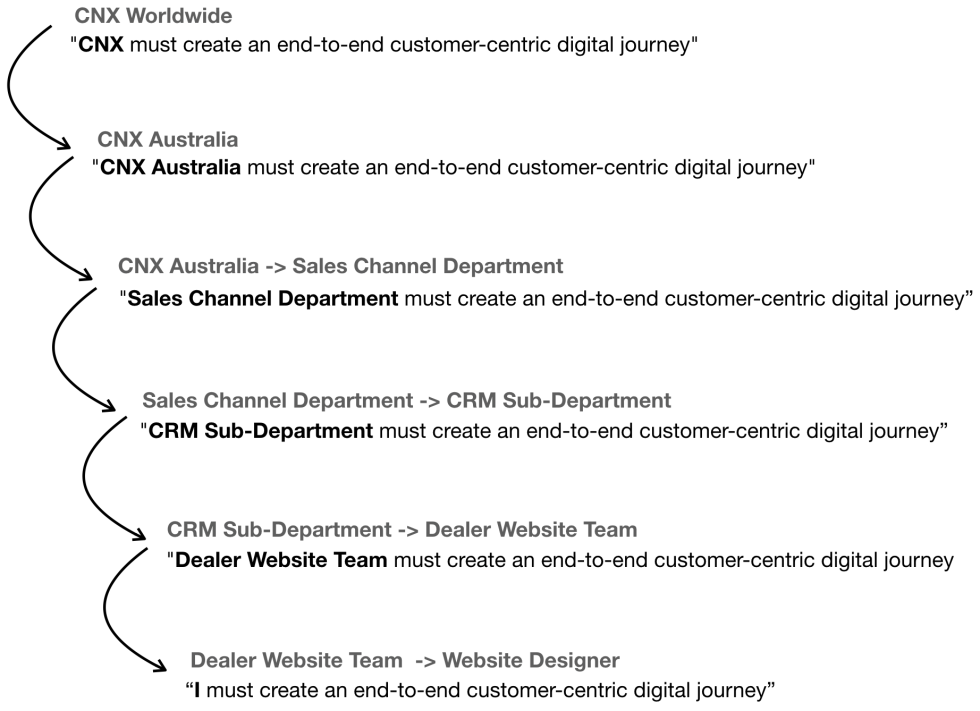
CEO/President. Let us assume that the key message for a global company headquartered in Europe for a worldwide change program is “CNX must create an end-to-end customer-centric digital journey”. The CNX presidents of each country’s legal entity should modify the message such as “CNX Australia must create an end-to-end customer-centric digital journey” and add proof points to support that message from a country’s perspective. A European centred message of company CNX may seem too distant or irrelevant for the Australian staff. Unless it is interpreted from a local business point-of-view, a European change message does not come home to the local staff.
Head of Departments. There could be various department heads reporting to the president and they too have to start taking the message and localizing it. For example, for the head of sales channel department this could mean “Sales Channel Department must create an end-to-end customer-centric digital journey”. These localised messages have to be continued to be supported by department-level proof points, bringing the change messages closer to the staff.
Managers. For the manager of the CRM sub-department sitting inside the sales channel department, this would translate into “CRM Sub-Department must create an end-to-end customer-centric digital journey. When the manager brings these messages to his team leaders, they now really understand what it means for them and their direct reports.
Teams. For the dealer website team leader sitting inside the CRM sub-department, the change message then becomes “Dealer Website team must create an end-to-end customer-centric digital journey”. Now a global change message to become more digital and more customer-centric has been cascaded down to the smallest local team in a language that they can understand and contribute to. This is the power of localizing change messages.
Note 1. A disciplined cascading of a global change message to local teams is a capability that not all companies possess. However, the purpose of the above example is to illustrate the positive change impact that companies can have on their staff if they know how to develop and communicate a good change key message.
Note 2. For departments and functions that are not customer facing per se, “customer” could be taken as the indirect customer or the internal customer.
#3. Make it Attractive
How: Use a strong, positive and appealing slogan to carry your message
Long Form. In one of my previous change projects, the task given to me was to communicate a new five-year company strategy across 12,000 people in 12 countries in the Asia-Pacific region for a global German company. The change message roughly was “The new strategy ensures our long-term profitability and sustainability.” I know the change message was not attractive-sounding but when it was successively interpreted and cascaded through the ranks, it became more relevant and easier to understand by the staff in every country and department. However, it was too corporate-sounding and formal to use in day-to-day conversations.
Short Form. We needed something shorter and sexier and we decided to use a slogan to carry the change message. Such campaign slogans are also alternatively known as war cries, rally cries, mottos etc. You can create slogans that are clever but you must be willing to spend time developing it. Regardless of whether it sounds clever, it has to be definitely short, simple, memorable and connect with the target audience. In many cases slogans, directly or indirectly, offer a promise of a better future which resonates with the target audience and I think that’s the secret sauce for a successful slogan.
“Make It Happen”. My communication team developed a change slogan which was a strong call-for-action phrase for the five-year company strategy in three simple words – “Make It Happen.” The slogan was used by the CEO and country presidents in many speeches, in team meetings, pantry conversations etc and with variations that fitted the conversations e.g. “Lets make it happen”, “Therefore we need to make this happen”, “Let’s go and make that happen” etc. A solid change communication campaign always uses powerful and action-oriented slogans.
Taking Motivation from Consumer Advertisements. In reality, advertisements are actually nothing more than intense change communication campaigns to promote certain desired consumer behaviors. Consumer brands are notoriously well-known for creating highly successful and memorable change slogans. Here are some famous examples:
- Apple: “Think Different”
- McDonald’s: “I’m Lovin’ It”
- KFC: “It’s Finger Lickin’ Good”
- Mercedes Benz: “The Best or Nothing”
- Nike: “Just Do It!” (used for 21 years)
- M&M: “Melts in Your Mouth, Not in Your Hands”
- De Beers: “A Diamond is Forever” (used for 67 years)
- Subway: “Eat Fresh”
- Tag Heuer: “Success. It’s a Mind Game”
- American Express: “Don’t leave home without it”
- Maxwell: “Good to the last drop” (used for 97 years)
- Avis: “We try harder” (used for 52 years)
- Vegas:“What happens in Vegas, stays in Vegas” (used for 11 years)
- Wendy’s: “Where’s the beef?”
- Mahatma Gandhi: “Quit India”
- Barrack Obama: “Yes We Can”
- Ronald Reagan: “Let’s Make America Great Again”
- “safety first”
- “Work smarter, not harder”
Use of slogan. Once you have developed an attractive slogan that carries the change message, you can use the slogan in a variety of ways. Leaders, managers, influencers and the project teams can use the slogan in speeches, conversations, PowerPoint, flyers, signs, posters, screen savers, banners, email signature footer, corporate gifts etc.
#4. Make it Visual
How: Use supporting key visuals to compliment your change slogan

Power of Pictures. The human brain is wired to process pictures faster than words and that’s why the advertising industry builds consumer brands not only with attractive slogans but also with appealing “key visuals”. The so-called “key visual” is nothing more than an image, a picture, an illustration that compliments or advances the key message contained in the slogan. We can learn from the advertising world and use relevant key visuals in our change communication campaigns.
Avoid Controversial Content. There have been many documented cases in the advertising world where companies have been chastened for using insensitive or controversial images in their advertising campaigns. You want to be completely as far away from these situations as possible for your change campaigns. You want to drive change, not create a public relations crisis. You might not also have the time or resources to recover from a public relations crisis coming out of using a controversial image.
Limitations of a Corporate Key Visual. For most companies and for most change campaigns, you would not have the luxury to use just any kind of image that you like. You will be restricted by the company’s core values, compliance considerations, corporate identity rules, design guidelines, wishes of the local management as well as your HQ etc. In fact, by the time your best options for key visuals cross these filters, they would have lost their initial authenticity. But this is common in the corporate world as the company has legal and ethical responsibilities and we have to accept it. Still a “sterilised” key visual is better than running a change communication campaign without one.
#5. Make it Heard
How: Repeat your change message in diverse communication channels

Use diverse communication channels. Developing a good change key message and supporting it with a slogan and a key visual are the first steps in content creation. The next step is to distribute them to your target audiences via diverse communication channels.
Different people like different communication channels. Different people relate to different types of communication channels differently. Some people may like to browse through an intranet website. Some others may like to thumb through a printed company newsletter. And there will be even others who may prefer a one-to-one personal conversation. Therefore, if you want to reach to as many of your target audiences as possible, you have to deliver your key message in as many different communication channels in your company as possible.
Each communication channel has its own inherent limitation. Also each communication channel has its own inherent set of advantages and disadvantages. For example, an email from the CEO about the change program, can reach a large group of people immediately and efficiently without cost but its a very cold medium and you do not know if people read your email, understood it and will do something about it. On the other hand, a face-to-face event, e.g. question and answer session with key stakeholders, can give you the opportunity to check if the audience understood the topics. But it takes time and sometimes some money to organise a successful corporate change event. And also not everyone can attend an event all at the same time. That is why you need a blend of diverse communication channels to deliver your key message. More tips and tricks on the different types of communication channels will be released in the next few weeks.
Use and Re-use. You need to have a frequency and reach plan to re-use and re-cycle these key messages repeatedly to your target audiences. Design the plan to mix and match these communication channels in a way that is efficient and effective. Communicate. Communicate. Communicate. Over communication is better than under communication during times of change.
Key Takeaways
Introduction. If the people did not hear and feel for your change message, they will not act or act in time and this will impact the success of your change program. That is why creating and communicating a solid change message is s crucial for the success of a change program.
#1. Make it Consistent. Use a messaging house template to structure and align the change key message and all supporting proof points into one page.
#2. Make it Relevant. Localise your key change message through all ranks and files so that it comes to closer and also makes sense to everyone.
#3. Make it Attractive. Use change slogans that are clever, simple and memorable and connects with the people.
#4. Make it Visual. Use an appealing key visual image to complement the change slogan as pictures talk louder and faster than words.
#5. Make it Heard. Use and re-use the change slogan and supporting key visual in as many different and diverse communication channels in the company as possible.

