
Introduction
Different types or communication activities. I have listed down 23 different communication activities below that I have often used before successfully for many change and communication-related projects. I am sharing them here in the hope that those in-charge of change who needs some tips and ideas could refer to them here. I have also offered to classify them in some meaningful ways as below:
| Event-Based Change Communication Activities | Supporting Change Communication Activities | |
| Common options | 1 CEO Speeches
2. Management Conference 3. Town hall Meetings 4. Department Meetings 5. Team Meetings 6. Workshops 7. Informal Team Gatherings 8. Personal Conversations |
12. CEO Letter
13. Fact Sheet 14. FAQ 15. Newsletters 16. Posters, Flyers, Decorations, Giveaways etc 17. Intranet Web Sites 18. Corporate Video |
| Additional options | 9. Staff Q&A Sessions
10. Roundtable Discussions 11. Staff Open Days |
19. Case Studies
20. Tool Kit 21. Handbook 22. Mobile Apps 23. VTMs |
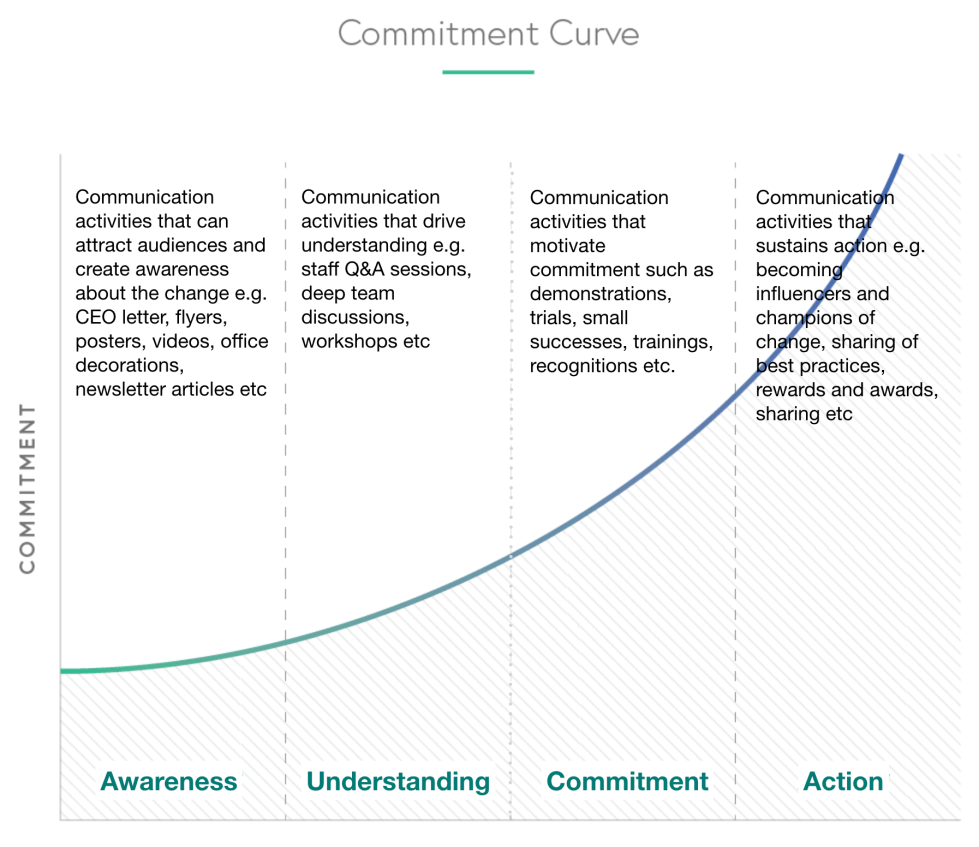
Communication activities vs the Committment curve. I have illustrated below an overview on how the different types of communication activities support the different phases of the committment curve. Please keep in mind that people do not move from one phase to another in tandem. It is not like that all the people in a company will be in the awareness phase for 4 weeks and then will jump to the understanding phase in unison. Most likely you will have different people in different phases all at the same time. Because different people will take different motivations and time to change to move from phase to phase. And you also have new comers to the company who will “join” the awareness phase while the rest of the company have moved-on. In addition, you will also have situations where people “fall-back” from a committment phase to a understandng phase because their efforts went unnoticed and therefore there was no motivation to proceed forth to the action phase but rather they went backwards.
| Comm. Activities |
Awareness |
Understanding | Committment |
Action |
| CEO Speeches / Letters | X | X | X | Χ |
| Management Conference | X | X | X | X |
| Town Hall Meetings | X | X | X | X |
| Department Meetings | X | X | X | X |
| Team Meetings | X | X | X | X |
| Workshops | X | X | ||
| Informal Team Gatherings | X | X | X | X |
| Personal Conversations | X | X | X | X |
| Staff Q&A Sessions | X | X | ||
| Roundtable Discussions | X | X | ||
| Staff Open Days | X | X | ||
| CEO Letter | X | |||
| Fact Sheet | X | |||
| FAQ | X | |||
| Newsletters | X | X | X | |
| Posters, Flyers, Giveaways etc | X | |||
| Intranet Web Sites | X | X | X | |
| Corporate Video | X | |||
| Case Studies | X | X | ||
| Tool Kit | X | X | ||
| Handbook | X | X | ||
| Mobile Apps | X | X | X | X |
| VTMs | X | X | X | X |
Caution 1. But please keep in mind that the role a communication activity can play in one phase in one project in one organisation could be different for another project for another organisation. Therefore some customizations and adaptations may be necessary. For example, a company, due to the technical nature of its change program, could decide to rely solely on using workshops to create awareness, drive understanding, promote committment and sustain action. However, another company might use workshops only during the committment stage because they only want to train those who have “signed-up”. Therefore whether a particular communication activity will be used in a certain phase or the manner in which it will be used will vary on a case-to-case basis.
Caution 2. This list is not definitive nor exhaustive and is purely based on my own personal experiences and observations on what worked and what did not for the projects that I was involved in. This is intended to be a starting point for you and to be enhanced, updated and expanded with your own learnings and experiences. And for my part, I will continue to update this list as necessary.
Caution 3. I have not added other activities which support change but may not be necessarily termed as a communication activity per se (maybe this is debatable). For example, here are some activities which I have not added into this chapter but I will reserve them for a future chapter:
- Training activities
- Business games
- Team activities and challenges
- Recognition program
- Etc
#1. CEO Speeches

Description
Speech by the CEO or president of the organisation to managers and/or staff. The occasion could be a company anniversary, an achivement of a company milestone, an annual management conference, during the occassion of a VIP visit from HQ, new office orplant opening ceremony or simply in an event specially created to launch the change program. The CEO’s speech can also be replaced by speeches by other board members and vice presidents but obviously will have a secondary impact.
+ Points
- Official endorsement. Offers the highest or one of the highest endorsements in the company for the change program, giving it great visibility, credibility, urgency and priority
- Communicate vision. Helps to communicate vision and purpose from a company and board point of view
- Time to be true. If the organisation has recognised and is willing to admit weakness or defeat in any areas, this is the best time to communicate it.
– Points
- Needs pre-alignment. Clear pre-alignment is needed with all the board members, which means it might need 2-4 weeks’ lead time
- Poor delivery. There is a risk that the delivery could be impacted negatively if the speaker is not proficient or experienced in public speaking. I know it sounds odd but I have seen this in real life many times – sometimes an awesome senior management executive might not make an awesome public speaker.
- Needs communication support. The CEO or the board members who are making the speech might need some speech preparation support from the communication teams or the project / change teams
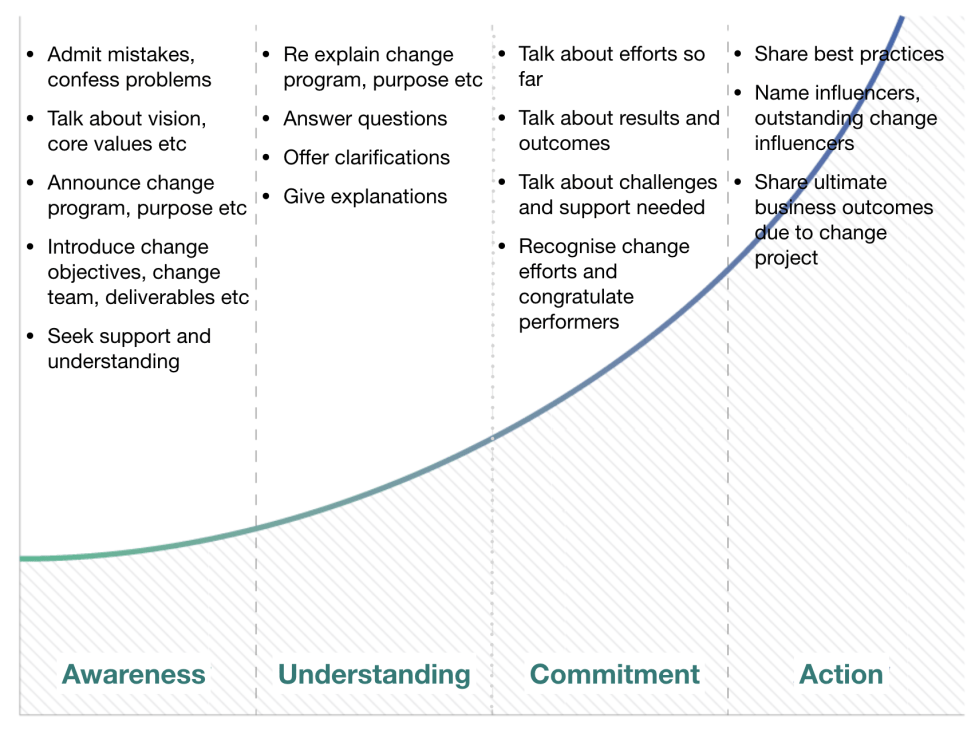
Different ways in which CEO speeches can be leveraged to support a change program
#2. Management Conference

Description
An annual or bi-annual or quarterly gathering of all the leaders and managers of the organisation face-to-face or via video conference. It can typically be from one day’s meeting agenda to a week long of speeches, presentations, seminars, workshops, trainings etc. Most organisations will have a management communication platform such as this and the change topic could be added as one of the topics in the agenda. Or if such a gathering does not exist or if an existing gathering’s agenda is tight, a separate conference could be conveyened dedicated to the change project especially if it is a key change.
+ Points
- Official endorsement. If the change topic is addressed in the management conference, it will be seen as of being high priority and important to the company and will receive quick and prompt attention from the managers
- Highly effective. Highly effective communication platform as leaders, managers and all relevant stakeholders could meet, interact and discuss face-to-face and clarify misunderstandings and strengthen common grounds
- Highly efficient. Speaking directly to a group of managers in one setting speeds up the communication process compared to taking days and weeks to communicate the same message via other channels such as CEO letters, emails, video clips etc
– Points
- Long preparation lead time. Such a management conference will take 3-6 months to prepare depending on the number of invitees and their availabilities, length and complexity of the conference agenda and any other special highlights etc product displays, demonstrations, guest speakers, participation from HQ etc
- Possible high organisational cost. A management conference could be organised in a lean way in-house using in house resources or in more flashy ways in hotels with catering and external agency support etc. In either case, some funding would be still needed
- Management alignments will take some effort. Compared to the logistics of organising such a management conference, seeking alignment with the CEO, board members and stakeholders for their participations and contributions can take a considerable amount of time and may not be the smoothest task
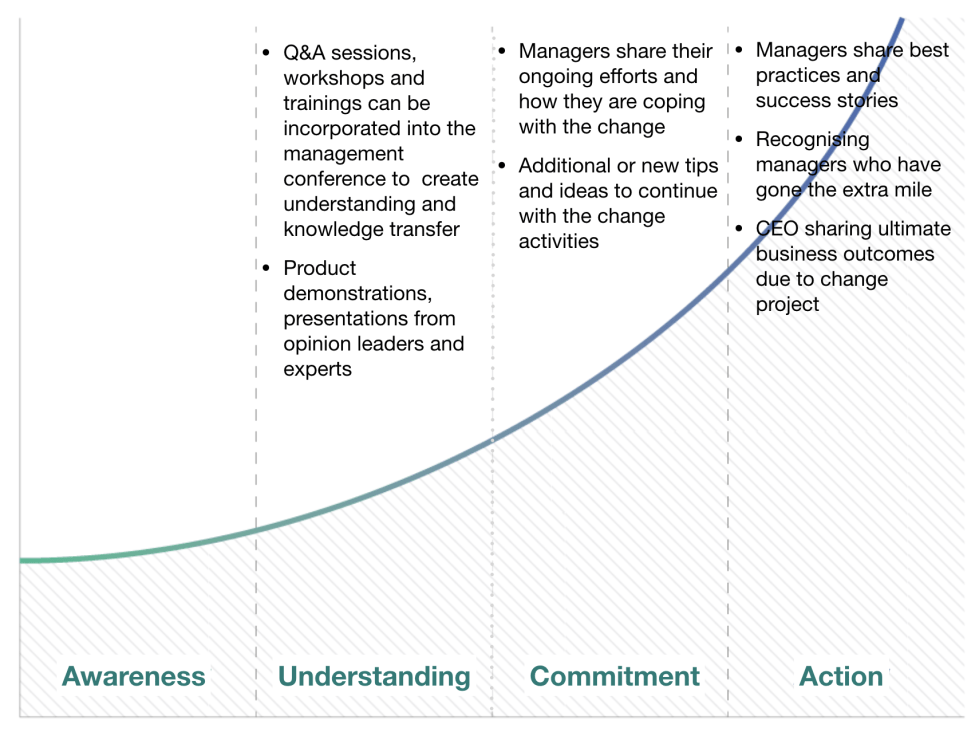
Different ways in which a management conference can be leveraged to support a change program
#3. Town Hall Meetings

Description
Regular staff meeting with all the staff in a company on a monthly or quarterly basis held by the CEO or VP or the department head. Normally this is held in-house and lasts for 60-90 minutes with updates on business performance, current challenges and support needed, upcoming products, key events, VIP visits etc.
+ Points
- Official endorsement. The CEO, VP or the heads of departments addressing the change issues in the town hall meeting is a very basic but important requirement and lends official endorsement and high priority to the project
- Highly effective. Highly effective communication platform where the leaders are directly talking about the change to staff face-to-face
- Highly efficient. Speaking directly to a group of staff in one setting speeds up the communication process compared to taking days and weeks to communicate the same message via other channels such as CEO letters, emails, video clips etc
– Points
- Lack of in-depth discussions. Due to the nature of regular town hall meetings’ agenda, the platform may not offer sufficient time for the leaders to go into details or depth
- Lack of full participation. Depending on the culture of the organisation, not all staff may attend the town hall meetings due to pre-occupation with other tasks, annual leave, external meetings, business trips etc
- Lack of interaction. Unless some form of Q&A session is built into the town hall meeting, most town hall meetings tend to be top-down, with little or no opportunity for staff to ask questions and receive clarifications. But you cannot built consensus if you do not exchange views
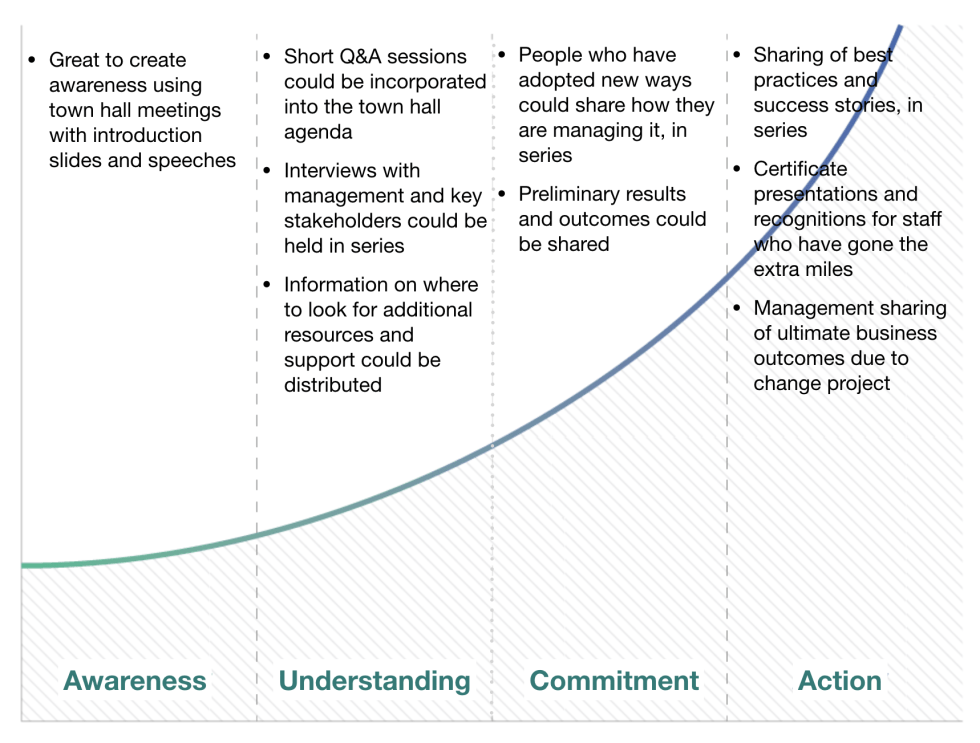
Different ways in which a town hall meeting can be leveraged to support a change program
#4. Department Meetings
Description
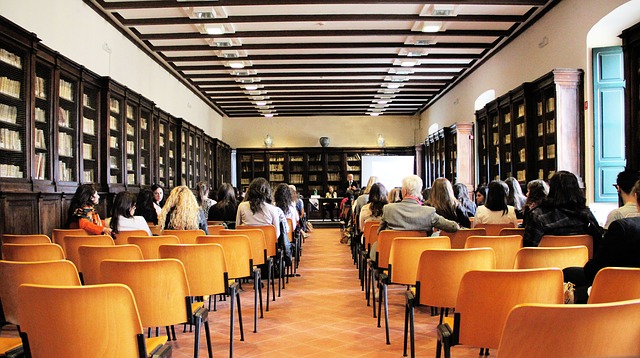
A regular meeting, e.g. monthly or quarterly, held by a department head for his direct managers and their staff. In some cases these department heads are the direct reports of the CEO or there could be another layer of hierarchy between them and the CEO, e.g. VPs
+ Points
- Official endorsement. Normally the general staff have limited interactions with the CEO or other board members in any given year. In most cases, it is the head of the department that the staff will see and accept as the face of the company’s management. They will be highly respected or feared by the staff and the topics that they touch on or focus on will be seen as being important by their managers and their staff
- Local interpretation. The head of department will be able to interpret or explain the need for the change, the goals of the change etc in terms of the department’s day-to-day tasks, needs and benefits. This filtering is important as it helps the department staff to see the connection between them and the change topic a little closer
- Too strong team culture. There are some cases in which managers of teams may have built a very strong sub-culture which can become challenging to penetrate with a message coming from outside the department. In such cases, department level meetings can help to create a better “balance” between team and department team/department/company goals
– Points
- Limited interaction. Staff may not ask many questions or interact closely with the head of the department since they are their immediate line manager’s boss
- Packed agenda. Since the head of the department will oversee many responsibilities, his/her department meeting agenda can be expected to be packed and therefore the time allocated to talk about a change program can be limited
- Not conneted to the ground well-enough. Because of the head of department’s high level position in the company, it is possible that they cannot see or do not understand the ground level issues that the staff face day-to-day. As such staff will not see them as being close to them. This is understandable and becomes the role of their immediate line managers.
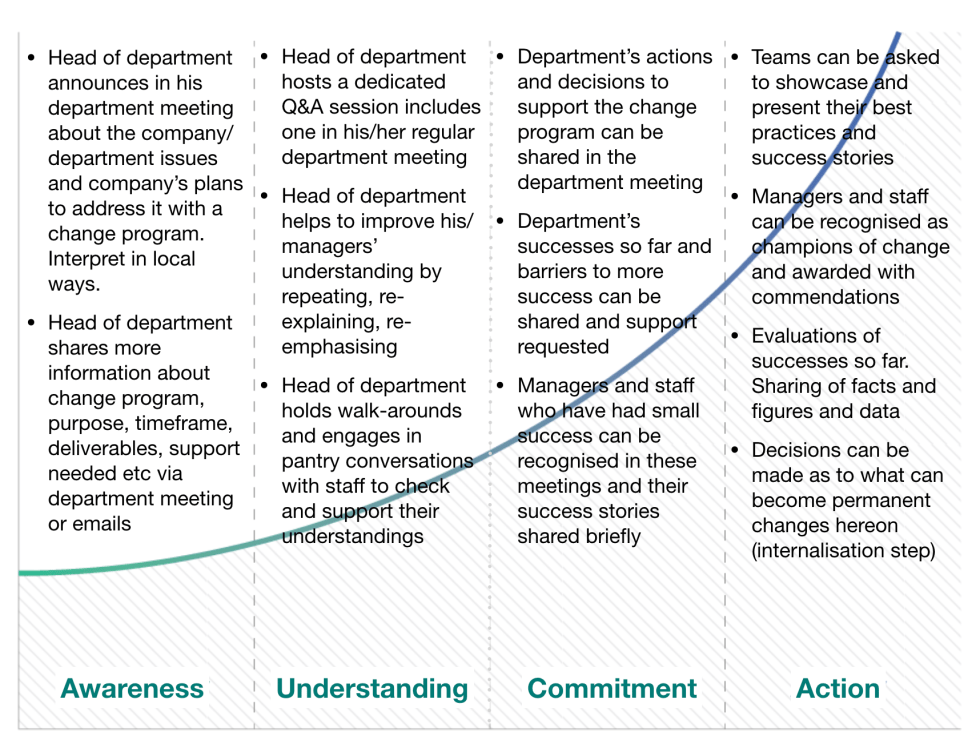
Different ways in which a department meeting can be leveraged to support a change program
#5. Team Meetings

Description
A regular, e.g. weekly or fortnightly, meeting between the manager or the team leader and his/her direct reports
+ Points
- Highly influential. Immediate line manager has immense influence on his direct staff and this influence can be positively exerted on his staff for change
- High frequency. Normally this is a weekly or even a fortnightly meeting or even a daily catch-up. This high frequency allows the manager to continuously monitor and enhance the change performance of his staff as well as receive feedback that he can act on
- Less formal. Such meetings are less formal than the department meetings and town-hall meetings. The staff is more relaxed and can give more open feedback.
– Points
- Limited information. The manager or team leader might not have access to all the information he needs
- Not enabled or equipped. The manager might not have the right motivation or skills to execute their change agent role in their regular team meetings
Different ways in which a department meeting can be leveraged to support a change program

#6. Workshops

Description
A highly interactive training cum group discussion format which can be used to create understanding and drive motivation.
+ Points
- Highly interactive. More interactive than a typical training format. Diverse views can be listened to and discussed.
- Highly customizable. Its easy to organise different types of workshops for different groups of people on different topics e.g. planning workshop, root cause analysis workshop, process improvement workshop, brain storming workshop etc
- Drives motivation. Workshops can be used to drive motivation by spreading common understanding, sharing of stories and contagious ideas etc
– Points
- Skilled moderator needed. The success of a workshop depends largely on the experience and skills of a key moderator. Experienced workshop moderators know how to create a positive energy “flow” in a workshop and to use that to shift mindsets during the workshop.
- Planning and preparation needed. For the best results, workshops have to be planned in advance e.g. workshop objectives and agenda developed, warm-up and group discussions activities planned, invitations sent out, logistics organised etc
- Short-lived. The momentum and positive energy created in a workshop can be very short-lived if there are no other change activities for the participants to sustain the momentum after the workshop. Therefore workshops have to be part of a larger change program and not stand alone.
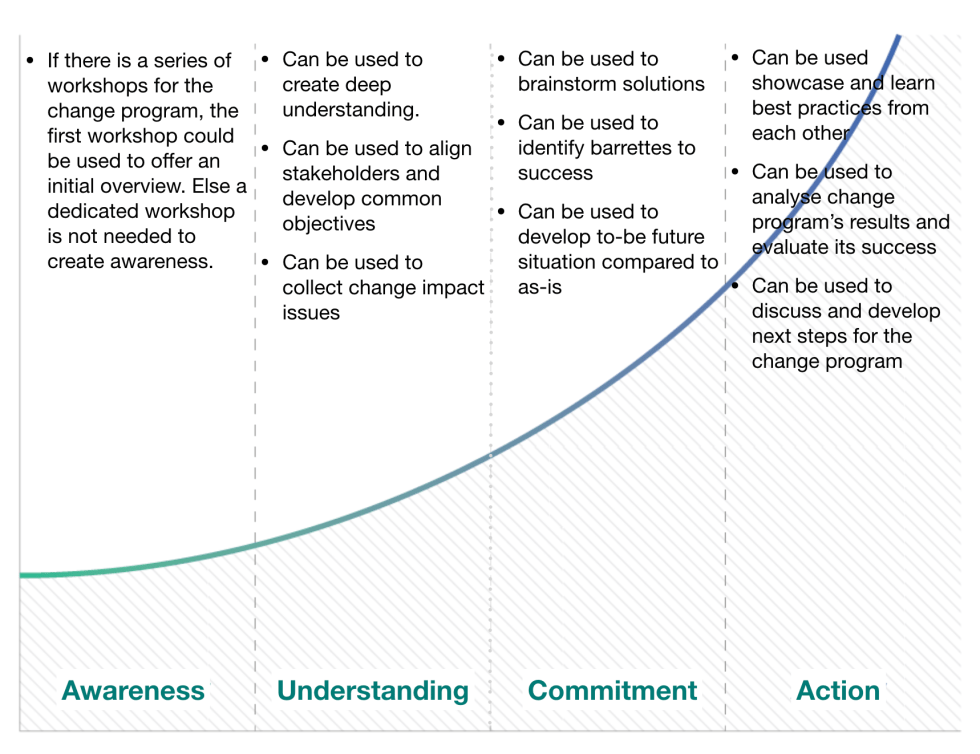
Different ways in which workshops can be leveraged to support a change program
#7. Informal Team Gatherings

Description
An informal team gathering in the company’s cafe or nearby lunch place. After work casual dinner would be even a better idea. Just by bringing a discussion away from a meeting room with Powerpoint slides to an outside location can drastically improve staff’s openness and willingness to talk and share more openly about the change and what’s working and what’s not working.
+ Points
- Great for open heart-to-heart discussions. A coffee environment is great for the team leader or manager to talk to staff. More importantly it’s a great opportunity to listen to ground sentiments and concerns about the change.
- No or little preparations needed. Unlike a formal meeting environment, no extensive preparations are needed from the manager’s side, except for a simple agenda and outcome planning which is not documented nor shared
- Easy to set-up. Compared to organising lunches or casual gatherings outside office hours, grabbing the people for a 30-60 minutes coffee time is very possible despite everyone’s busy schedule in office
– Points
- Manager’s role. If the manager does not put on a “open and positive” outlook to facilitate the conversations in a coffee session, you might not get people to open up and share their real thoughts
- Moderation. Depending what is the manager’s purpose for the coffee session, he/she has to steer the discussion to achieve the results else it can just be a coffee session without advancing the change solution – which in it itself is also perfectly fine if that was the purpose
- Lack of results. If the people do not relax, are “stiff” and are reluctant to share freely, you will not get that informal and frank feedback. Perhaps people need an even longer time to open up and an out-of-office lunch or dinner could be a solution
Different ways in which informal team gatherings can be leveraged to support a change program
Same approach as for “Team Meetings” but without any fixed agenda, PowerPoint presentations or project documents. Same tasks and actions but in an informal and casual way. With more space and freedom for staff to talk, exchange and share. Manager can help to connect dots, reaffirm directions, be personal by speaking from his/her heart and show passion for the change results.
#8. Personal Conversations

Description
Short one-to-one informal and unofficial chat between manager and staff or between stakeholders, between staffs etc normally in the course of the day-to-work e.g. pantry conversations, elevator speeches, lunches, coffee etc
+ Points
- Highly effective. Such one-to-one conversations can be highly effective if both of them trust each other and are sincere. If you can spread positive change key messages to managers and influencers, they can help to spread it around the office via one-to-one conversations
- Logistically easy. It is easy to organise because there are only two people to align on date, time and venue and at other times it just happens
- Heart-to-heart. The conversation can be personal and touch heart-to-heart issues
– Points
- Grapevine. The conversations could also be “gossipy” which, though is not encouraged, is an intrinsic part of every organisation
Different ways in which personal conversations can be leveraged to support a change program
Same as for “#7. Informal Team Gatherings” but on a one-to-one and a very personal basis. With plenty of time and freedom to catch up on personal updates such as family, holidays, work, career etc. This foundation is important for the rest of the conversation which focuses on the same tasks as for #7 but just keeping it more personalised for the individual.
#9. Staff Q&A Sessions
Description
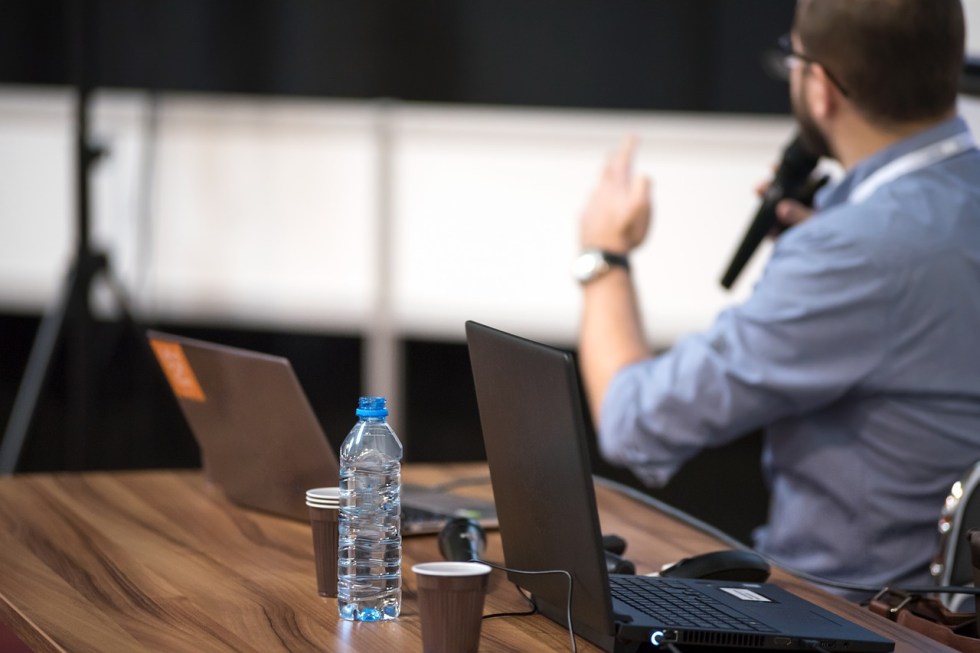
All hands open meeting between staff and/or management / stakeholders / project team / technical experts to clarify topics in a question-and-answer format. The questions from the staff could be received by email or message boards earlier and/or received onsite on the actual day.
+ Points
- Creates trust. Staff will appreciate that the management has taken the time to answer their questions personally and it also helps to build trust on the topics that the management wishes to seek their support.
- Interactive. Great interactive communication platform for staff to get a better understanding of the change issues and support needed, compared to a speech or a presentation.
- Face-to-face. Face-to-face (or video conference) makes this a highly effective communication channel compared to intranet sites, videos, emails etc
– Points
- Preparation needed. Presenters may need to prepare beforehand a list of frequently asked questions and organise the answers
- Contigency for unexpected situations. Need to have a contingency plan or Plan B to manage unexpected questions or criticisms from the floor. Who is going to address what topics?
- Limited audience participation. Not all invited staff will be able to attend due to meeting clashes, on leave, too busy etc
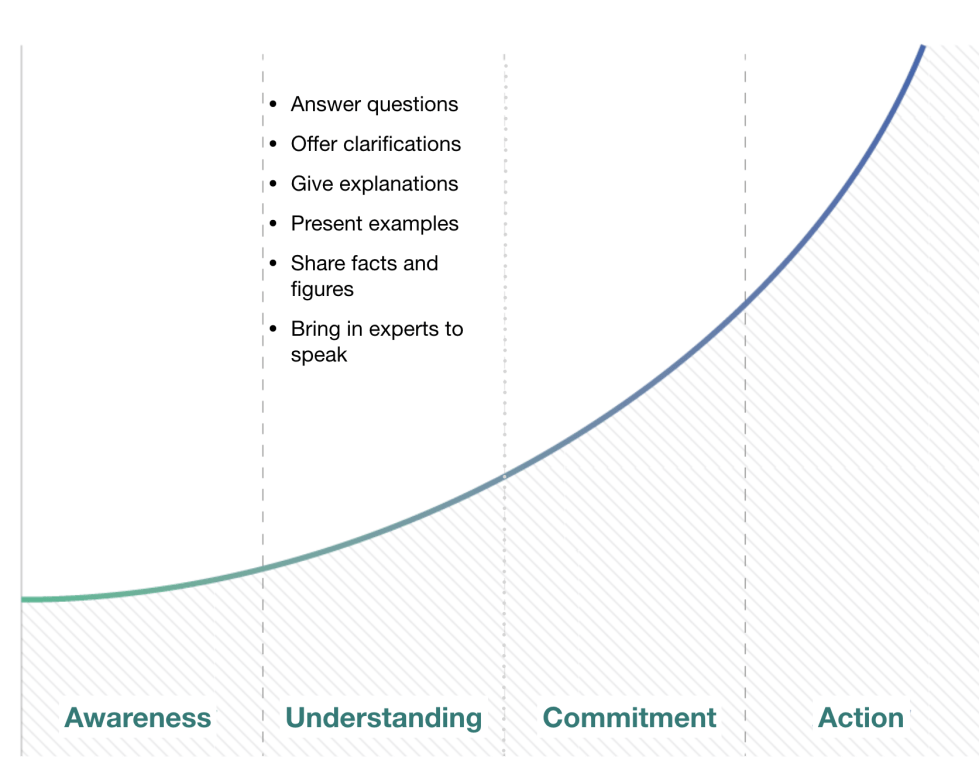
Different ways in which staff Q&A sessions can be leveraged to support a change program
#10. Roundtable Discussions
Description
Normally a formal event in which key management colleagues, technical experts and stakeholders are invited for a “live” discussion on a chosen topic in front of an audience moderated by an experienced host.
+ Points
- Transparency. Such a discussion can offer great transparency on the issues involved if the people chosen to talk are experts and can talk openly and candidly
- Interesting. Roundtable discussions can offer a wonderful combination of information and light humor due to the live interactive nature of the format
- Audience participation. Audience can also be invited to participate in the roundtable session to hear what are their thoughts on the issues being discussed
– Points
- Viewed as a staged propaganda. Staff could think that the discussions are staged and not spontaneous or sincere. The only way to go around this is for the speakers to come across authentic and compassionate.
- Reluctant speakers. It might be difficult to convince some speakers to participate in the roundtable discussions because they are not confident of imprompu speeches
- Uncertainties. It is also possible that some discussions could go in a completely unexpected direction causing embarrassment or hurt to others. The role of the moderator is extremely crucial here.
Different ways in which roundtable sessions can be leveraged to support a change program

#11. Staff Open Days

Description
A large staff event in which all impacted people are invited to attend where senior leaders, stakeholders, project team and champions of change exchange information using different formats such as speeches, displays, demonstrations, Q&A sessions, mini-workshops, movie screenings etc.
+ Points
- Dedicated event. Unlike a town hall meeting, a staff open day could be dedicated 100% to the change topic if desired. But it could also be part of a larger agenda e.g. company culture day, in which the change topic is addressed as one part
- Staff engagement. Open days are a great way to get the staff engaged and to motivate them to try new behaviors and adopt a new mindsets.
- Highly efficient. Open days are a highly efficient communication activity because it is a face-to-face.
– Points
- Costly. On one end, it can be held in a large meeting room with some speeches and PowerPoint presentations with coffee and snacks in a very simple way. On the other end you can organise it in an external venue e.g. function room in a hotel with stage, sound and light systems, catering, program hosts etc. Your open day concept can fall anywhere between these extremes, based on how ambitious you are and your constraints.
- Balance between speech and interactive elements. You need to keep a healthy balance beween speechs and interactive activities for the staff. In many company events, the management normally looses the staff with a series of long opening speeches.
- Limited follow-up. It’s quite easy for these events to be successful but without a properly structured change plan with follow-up change activities, it can simple become a hot-air event.
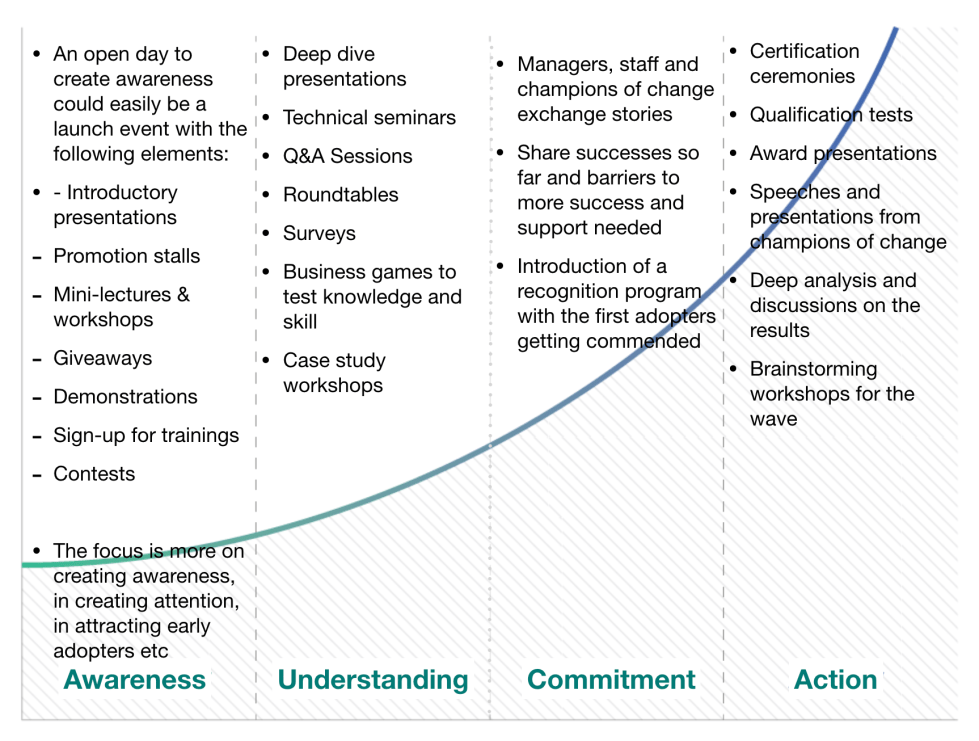
Different ways in which open days can be leveraged to support a change program
#12. CEO Letter

Description
Direct letter from the CEO or President of the company to all managers or managers and staff on a change topic.
+ Points
- Strong endorsement. Such a letter will carry the weight of the CEO or President’s office on the topic being addressed and will attract high visibility from the staff
- Transparency and clarity. The key message and proof points will be transferred to the staff more accurately than through verbal cascading, for example from CEO to heads of departments to managers to staff. It can help to avoid misunderstandings and reduce confusion
- Official. Such letters are normally seen by staff as being official and accurate
– Points
- Needs to be part of a communication campaign. Unless the letter was preceded or superseded by additional communication activities to the staff, the letter would seem quite odd, like a letter out-of-the-blue, unsupported, uncoordinated and standing alone
- Preparation. It would be better if the letter was prepared with the support of the organisation’s communication department and the change team to ensure proper messaging
- Passive. It is less passive than actually hearing the CEO delivering it. Audience will not receive the “non-verbal” communication part of the speech version which makes up a big part of what is actually said
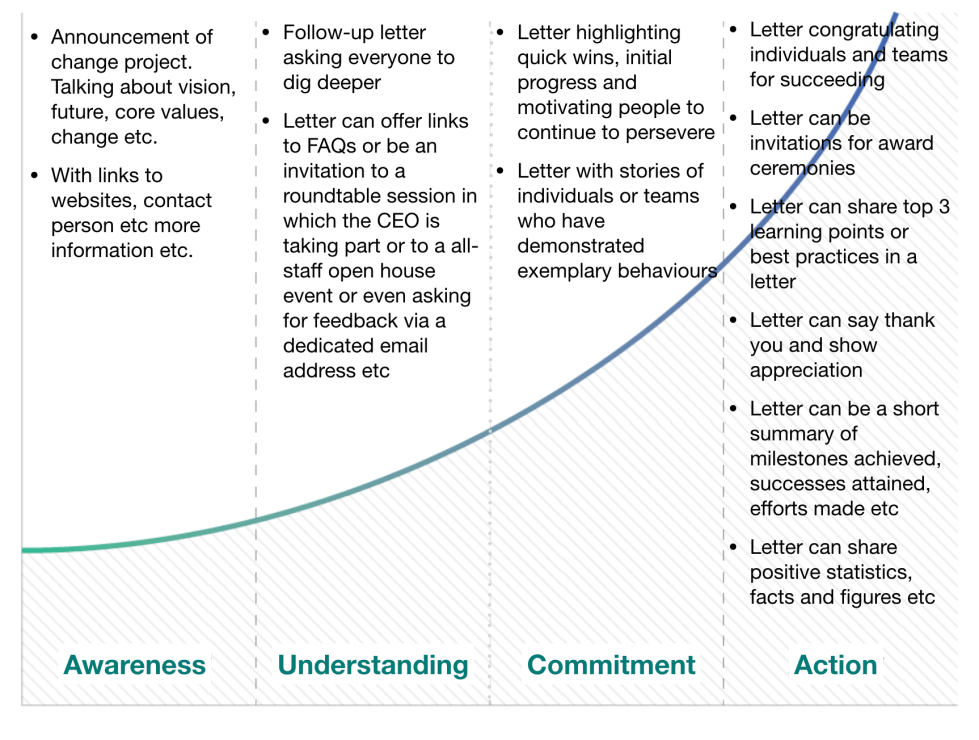
Different ways in which CEO letters can be leveraged to support a change program
#13. Fact Sheet
Description
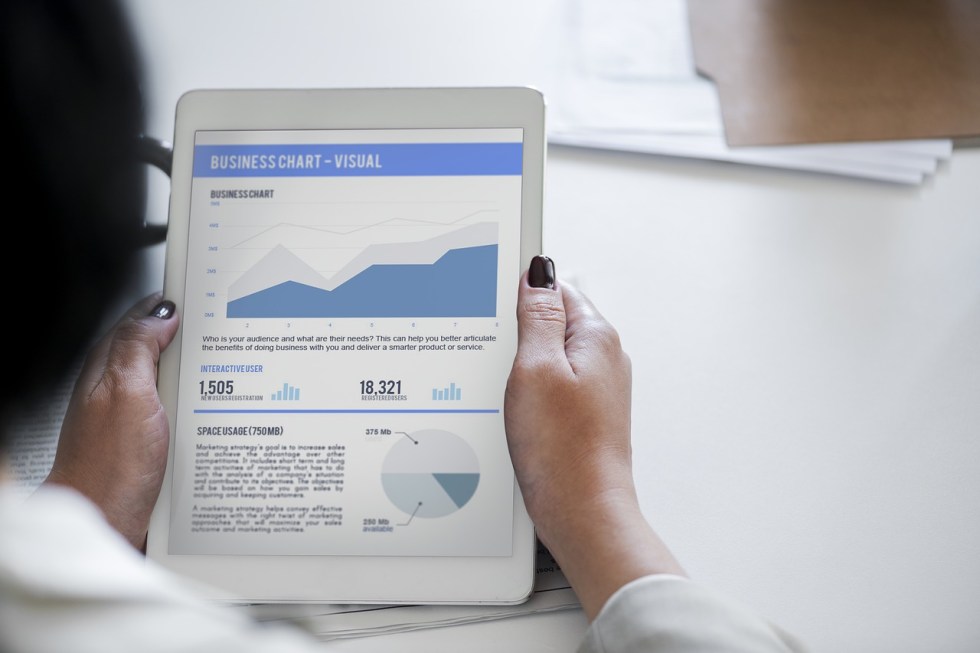
A summary of the most important points you need to know about a change program in one page printed or in a softcopy version. It can alternatively be also called “At a glance” document.
+ Points
- Quick preparation. A fact sheet can be prepared in a relatively short amount of time in-house if its developed by the expert in the area
- Quick understanding. The format allows a quick transfer of key information to a target audience. Within a few minutes, the target audience can get a big picture view of the change project
- Quick distribution. The fact sheet can also be quickly distributed as handouts in town hall meetings, workshops, team meetings etc or downloaded
– Points
- Format not for details. The concept for the fact sheet inherently does not allow it to go into details. The format wins only if it sticks to a summary of the main points.
- Easily outdated. As soon as the target audience has overcome the need to have a big picture or a quick overview, they will discard the fact sheets as they will be become redundant
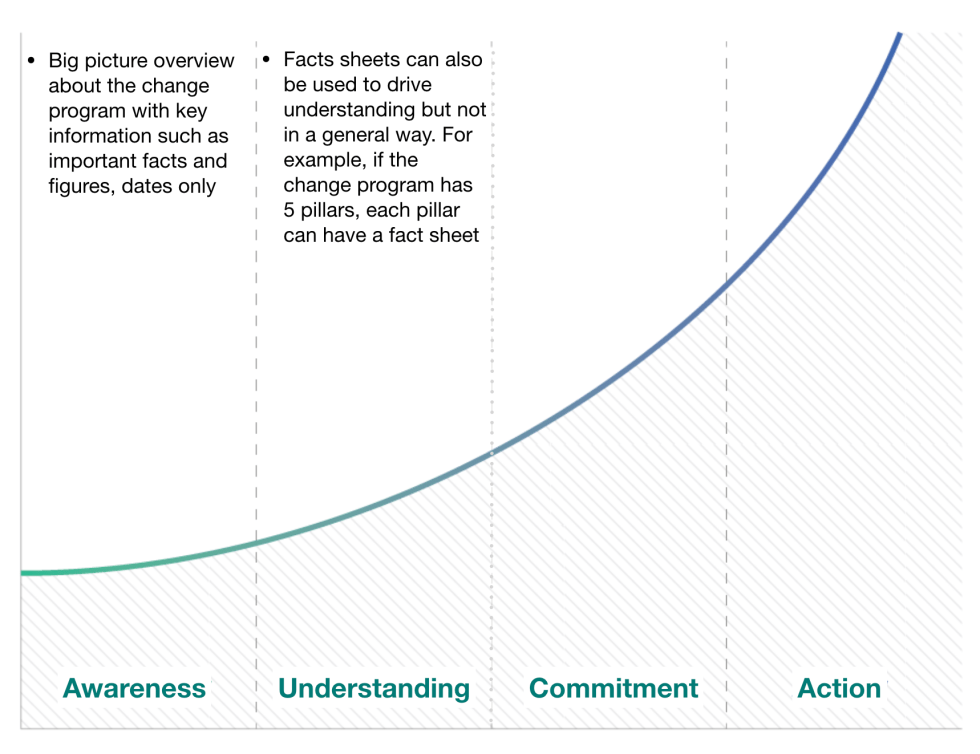
Different ways in which fact sheets can be leveraged to support a change program
#14. FAQ
Description
A list of commonly asked questions and answers from the experts closest to the topic.
+ Points
- Improves understanding. FAQs are a great way to improve understanding on new topics. These are questions that normally everyone has in their minds but are afraid or too shy to ask
- Saves time and resources. The FAQ saves times and resources by taking care of the most commonly asked questions so that you don’t have to repeat the answers again and again. This saved time could be channelled to more specific or more challenging questions
- Fast and efficient. It is easy to develop a FAQ and to distribute it to staff
– Points
- Outdated. It can get outdated fast and needs to be expanded or a new FAQ has t be started to support the next phase of the project.
- Accuracy. The answers have to be verified before publishing them.
- Brief answers. The answers are normally kept brief and to the point. Staff who needs more detailed answers will have to refer to websites, PowerPoints, handbooks etc
Different ways in which an FAQ can be leveraged to support a change program

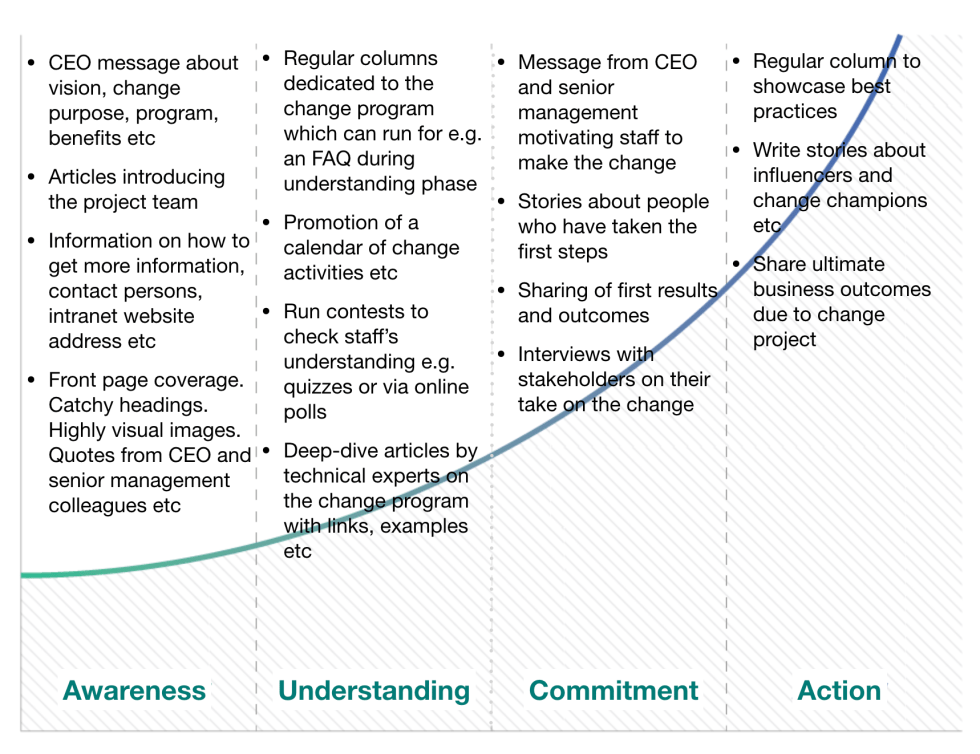
#15. Newsletters

Description
Printed or electronic compilation of company, products or staff related news distributed regularly to a specific target audience.
+ Points
- Corporate voice of the company. News and information in the company’s newsletter is trusted and is seen as being credible and accurate.
- Professional image. In most cases, since it’s a company newsletter, the production looks professional and brings a good reputation to the topics featured in the newsletter
- Timely. Depending on the company, most newsletters are monthly, fortnightly or even weekly. This brings relevant news to the target audience in a timely fashion
– Points
- Unclear readership. You are never clear about how many people are reading your news articles unless you organise regular contests and surveys. This becomes worst if there are several newsletters in an organisation.
- Production time needed. Depending on the ambition and size of the newsletter, 1-2 weeks’ production might be needed to collect news from various stakeholders, write it, edit it, add a photo, design it and distribute it electronically. It will longer for hard copies.
- Cost. In many cases, a graphic designer is needed to do the layout of the newsletter and convert it into an electronic newsletter or to print hard copies.
Different ways in which newsletters can be leveraged to support a change program
#16. Posters, Flyers, Decorations, Giveaways etc

Description
Printed or electronic promotional materials used to dress up the office and create a conducive environment for change
+ Points
- Costs. In most cases, you will need some funding for designing and printing these materials
- Good visibility and publicity. The materials can create visibility for the change campaign which can be complimented with other electronic communication activities
– Points
- Time. You will need to set aside minimum three months to brainstorm concepts, hire agencies, design, print and distribute these materials to the managers and staff
- Positive environment. “Dressing” of the office or the plant with these materials helps to create a positive change environment
- Wastage. Most of the promotional materials will be irrelevant after the campaign is over and have to be thrown away unless it was centered on something more sustainable such as core values or culture
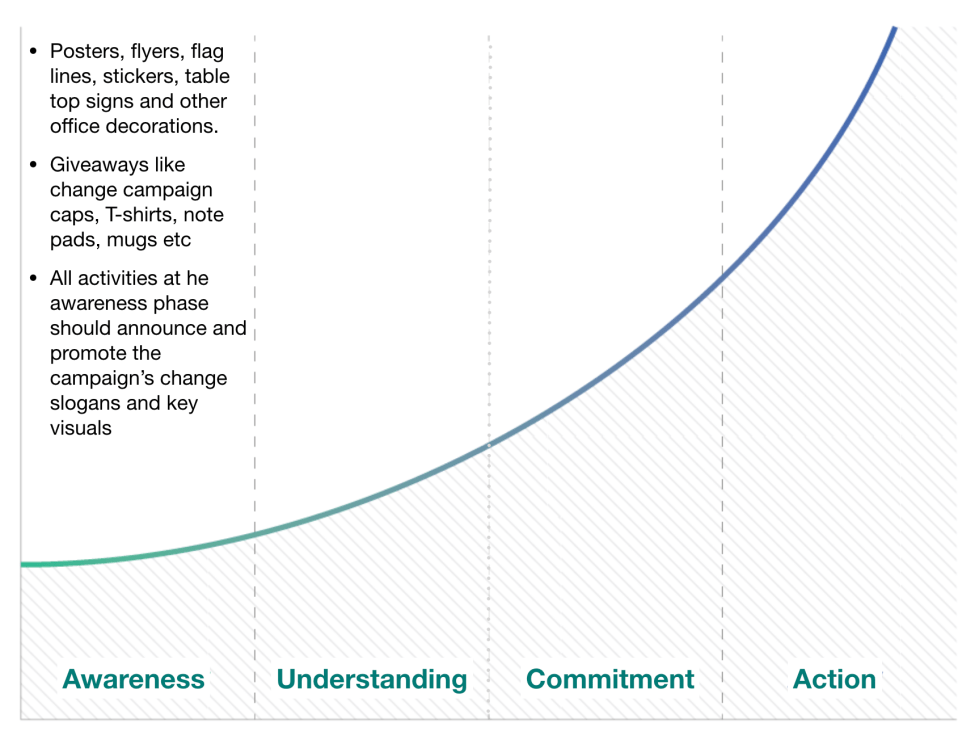
Different ways in which posters, flyers, decorations, giveaways etc can be leveraged to support a change program
#17. Intranet Web Sites
Description
Company’s internal information-sharing system where the company, the different functions and their programs and projects can have different websites, managed in-house.
+ Points
- Highly efficient. You can share and distribute information to managers and staff almost immediately
- Always available 24/7. Unlike paper materials or emails which can get lost, news and information distributed via the intranet always remains there 24/7 in the same location
- Zero cost. This is the most common and most preferred communication platform normally in an organisation because its there and its free
– Points
- Boring communication. The is not the most exciting communication platform e.g. compared to a face-to-face Q&A session
- Staff can get lost. If the organisation has a large an intranet or if it is not properly organised, staff will normally get lost and will not be able to find the right resource when they need it and this will impact their performance
- Technical knowledge required. You need at least some basic technical knowledge to set-up and maintain an intranet site, which can normaly be learned in-house, 2-4 weeks on-the-job.
Different ways in which intranet websites can be leveraged to support a change program
Similar to the mobile apps, many of the activities described here can be carried onto the organisation’s intranet web sites. A dedicated web site could be created and everything could be mirrored here even though other communication channels are used. This could be a “one-stop place” where everything is one place.
#18. Video

Description
2-3 minutes long video featuring company’s leaders, stakeholders, technical experts and general staff talking about the challenges and solutions for the future. The tone is normally formal and the speeches are scripted and everything is rehearsed and shot.
+ Points
- Official endorsements. Corporate video always has this aura of official-dom to it. The communication comes across as credible and official and almost as a given-promise from the company.
- Professional image for change project. The company and the change issues will gain a professional image and reputation from a publicity point of view
- Easy to share. The video came be shared with staff and virtual teams in multiple ways – via intranet links, via mobile phone apps, via events etc.
– Points
- Long lead time. It will take 3-6 months to script and produce a high quality video, also depending on the experience of the local communication team, supporting external agency and availability and support of the people featured in the video
- Need funding. Vidoe will need a large funding support as professional looking videos need professional video, editing and sound crew and in some cases may also need a director
- Limited shelf-life. For example, a video shot to create awareness for a change project will go outdated when the project reaches a mature state when no one needs to see the introduciton video again [except for new comers, interns etc]. The staff might need other types of videos to support their current stage but not the introduction video.
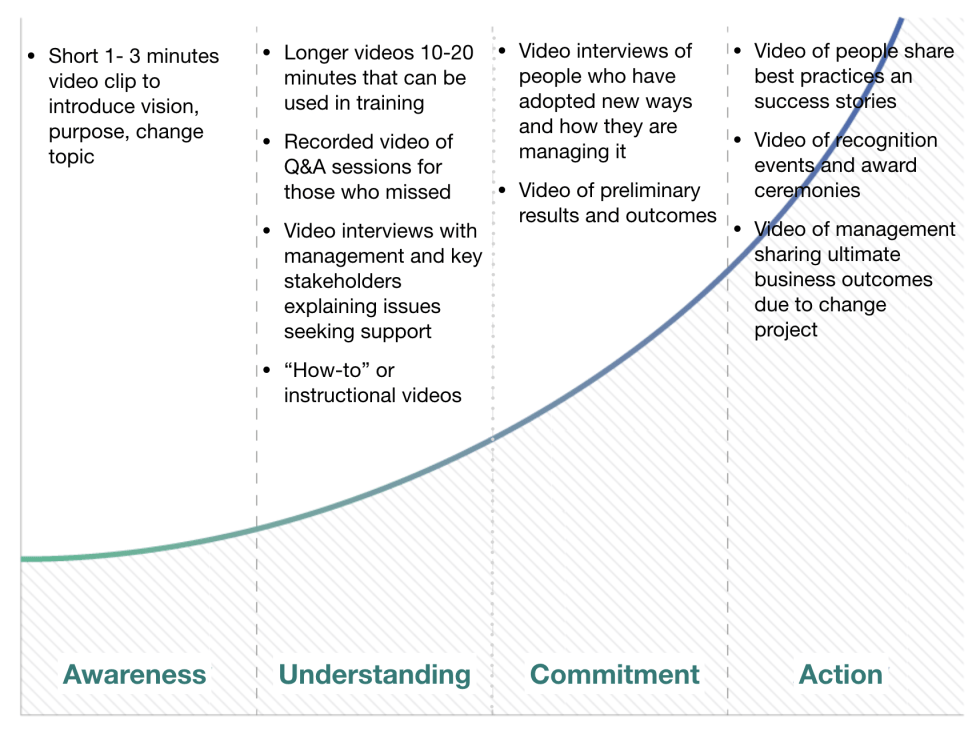
Different ways in which video can be leveraged to support a change program
#19. Case Studies

Description
A real or hypothetical business case is discussed by participants to discuss, develop and debate possible solutions, thereby gaining a deeper understanding of the change issue in the process.
+ Points
- Deep understanding. Great tool to offer a deep understanding to the people in a stimulating and engaging manner.
- Highly relevant. The case study can be made directly relevant to the change program and the issues at hand, thereby putting a spot-light on where it matters most. For these purposes, case studies based on real life business situations are highy recommended.
- Brainstorm solutions. It is also a great tool to bring together people with different ideas and skills to focus on a specific issue and to discuss and develop solutions jointly.
– Points
- Preparation. While it is not rocket science to write-up a case study, management and stakeholders must agree to use their specific topics as examples and basis for the case studies for the benefit of everyone.
- Moderator. The moderator’s role is important to facilitate the discussion else you will not get the desired results. Leading but without directly contributing. Encouraging the discussions but also controlling the discussion’s pace and direction.
- Participation. It’s best to invite those who are directly involved and/or impacted by the change for an active and useful discussion. Else the participants will not engage in the discussions because the issues or topics in the case studies do not really concern them or they can’t see the connection to them.
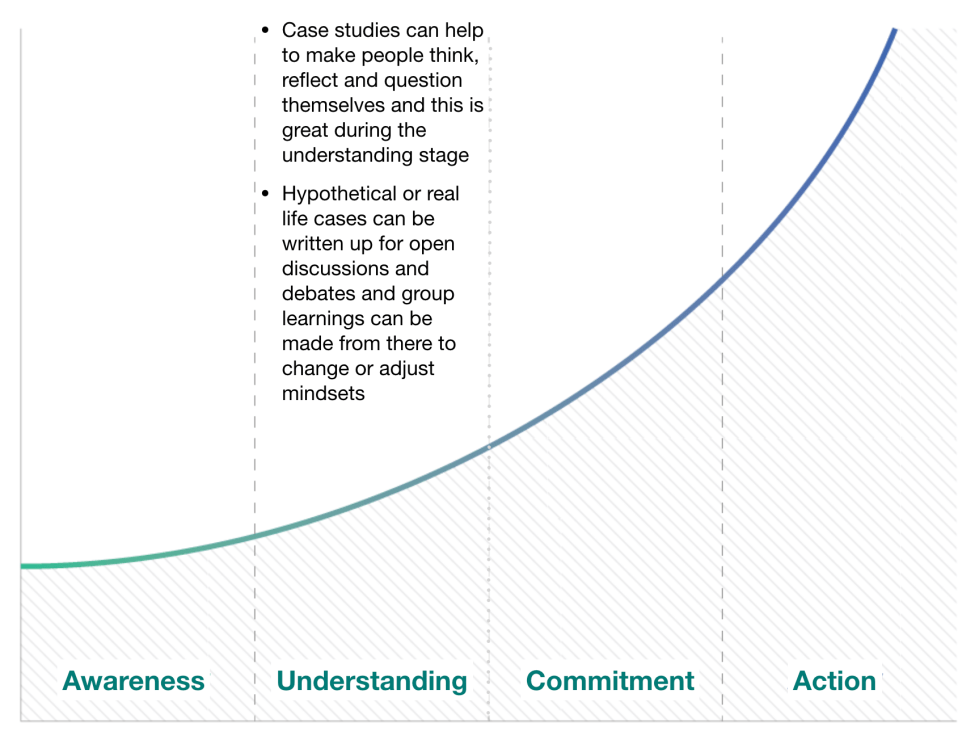
Different ways in which case studies can be leveraged to support a change program
#20. Tool Kit
Description
A consolidation of all the tips and tricks that you want to enable a set of target audience with. The target audience could be managers, change champions, users of a new system etc and the content be skills, attributes of the new system, set of tips or ideas etc. The tool kit could be in the form of an intranet site, a deck of PowerPoint slides, a printed physical booklet or even a box of cards that you can carry in your pocket.
+ Points
- Highly efficient. A tool kit puts in one place all the best practices, information or knowledge needed in an efficient way to use. Users do not have to refer to multiple sources or handouts or notes. This makes it easier for the group to access and use the ideas
- Updatable and expandable. Regardless of the form of the tool kit there are always possibilities to update or expand the collection of ideas making it sustainable
- Easy to use. The concept of a collection of tools makes it easy for users to connect and use the tool kit
– Points
- Setting-up. Technical experts need to brainstorm and develop the tool kit and this may take some time and effort. The tool kit also needs to be written-up professionally, with images, process charts, benefits, links etc
- Production cost. The toolkit can cost less if it remains a PowerPoint deck. However if you want to explore more attractive formats such as booklet, pack of cards etc, you need a print production budget and timeline.
- Insufficiently used. After the initial buzz, some users might not use the tool kit in the fullest manner and it could be locked up in a drawer for sometime before being thrown away
Different ways in which a tool kit can be leveraged to support a change program

#21. Handbook

Description
A handy and useful compilation of all the tips and tricks a target audience needs to know to get some tasks completed. It normally will have goals and targets explained, processes, timelines, tips and recommendations, contact information and resources. Nowadays this is quite commonly done in an electronic way using an intranet website.
+ Points
- All at one place. It makes it easy for the user to use it because it’s all in one place physically
- 24/7 Availability. Unlike a training or a workshop, you can refer to your handbook anytime to continue your learning process 24/7
- Customise. It allows users to jot down additional notes and points into the handbook and it stays together in one book, strengthening their personal understanding
– Points
- Costly. Printing a handbook is not very common nowadays due to the costs. But it could be an electronic version which would be more affordable. But it would still need some designing costs to keep it attractive for users to use.
- Left in a drawer. If the handbook is big and bulky or does not really offer useful information or if the target audience is not motivated, the hand book will be left in the drawer and forgotten
- Updating and expansion. An online version of the handbook can be updated and expanded anytime where else it will be more difficult, costly and take a longer time if it’s a hardcopy.
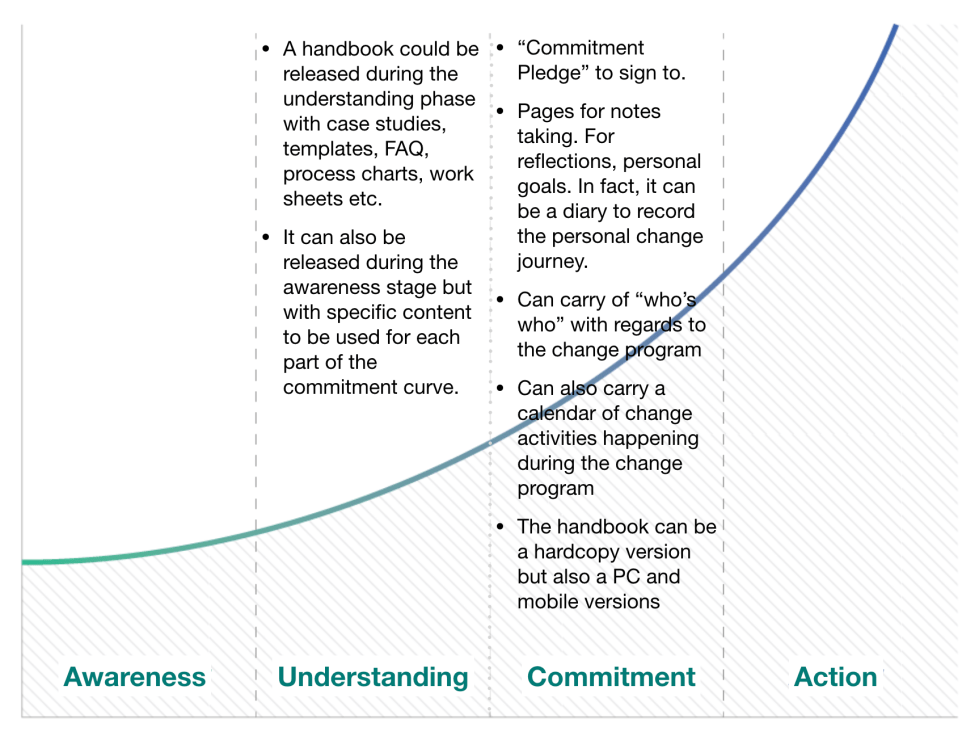
Different ways in which a handbook can be leveraged to support a change program
#22. Mobile Apps
Description
Social media or company proprietory apps that allow people in a change program to update progress, to share best practices and results and to motivate each other through change e.g. WeChat in China, Whatsap in the rest of the world, mobile-based training, polls etc
+ Points
- Highly efficient. Mobile apps are very handy and accessible and allows users to connect with the topic throughout the day in a very direct manner
- Highly effective. Depending on how the app is used, it can be a very powerful and effective tool to create momentum in the change program
- Highly interactive. The mobile app allows users to share as well as to give comments and feedback, give thumbs up, rank etc which makes the tool very interactive for everyone
– Points
- Cost. There may be some licensing or app development costs to set-up a mobile app for your change program. But I would highly recommend it especially if you have people who work in plants and do not have email access
- Privacy and compliance issues. The company’s legal, compliance and IT teams have to mitigate risks coming out of the fact that sensitive company information may become public accidentally
- Insufficient or improper use. There is also the possibility of a poor participation rate from the staff. The leadership and the managers should join and participate first and also encourage others’ participation. Also the app should be tied into the change program in a tight way and not stand alone as a separate activity. Secondly, to ensure that the tool supports the change program and is not abused or misused for other purposes or agenda, proper and prior communication and training is needed for the users
Different ways in which mobile apps can be leveraged to support a change program
Mobile apps make many of the communication activities described here more efficient and more accessible. For example, if there is a company or project app, results from the Q&A sessions, summary of the roundtable sessions, FAQ, fact sheets etc can all be uploaded here. Also process charts, handbook and tools can be made available on mobile etc. Agenda and registration for staff open day can be made via mobile etc.
#23. VTMs
Description
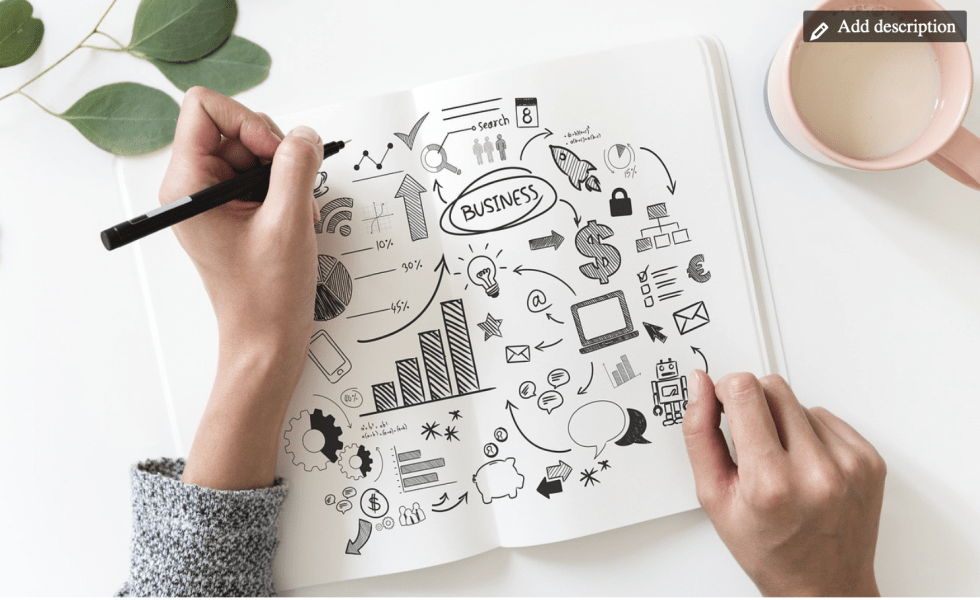
VTM or Visual Thinking Map is a drawing and mapping technique used to communicate complex or uninteresting messages into highly visual and attractive images for the target audience
+ Points
- Makes complex easy. Simplifying and drawing out complex strategies, goals etc can make it easier for the people to understand and support it. It is also an excellent way to give someone a high level big picture without making it complicated
- Communication content for change program. The results of the VTM exercises can be used as an important content for the change program. For example a drawing of the “old world” (scenarious and people behaviors before change) vs the “new world’ (after change) can be picturised and used in change documents, posters, case studies, websites etc
- Great group exercise. VTM can be a great way to bring people together to discuss issues, develop and align solutions and to also communicate it to the rest of the organisation
– Points
- Enabling needed. Teams need to be trained or enabled on how to use drawing techniques. The myth that drawing skills are needed has to be dispelled and awareness created that anyone can use VTM successfully
- Resistance. There can be audiences which think that drawing is an inferior way of developing or communicating solutions as opposed to using texts in slides. VTM does not replace texts or slides but only compliments it
- Time and money needed. You need to set aside time to organise a VTM activity. The final agreed drawing result can be given to a professional illustrator or graphic designer to create key visuals which can be used in the change communication campaign
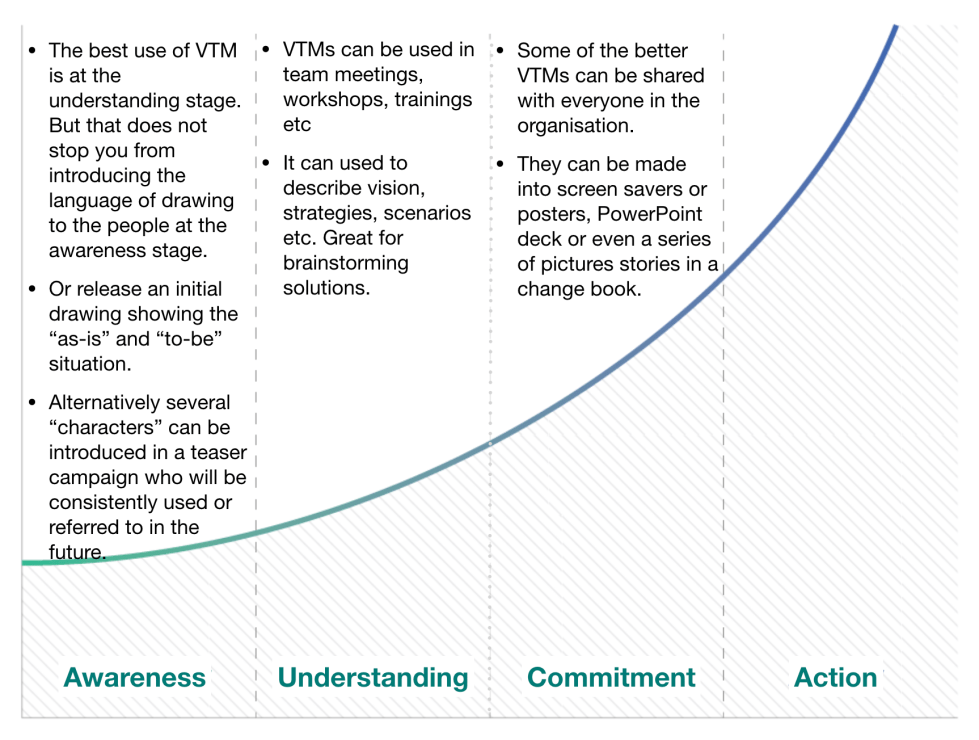
Different ways in which VTMs can be leveraged to support a change program
Key Takeaways
- Communication is the Great Enabler of Change. But different people respond to different types of communication activities in different ways. Therefore you need to carry your change messages to the people using a diversity of attractive means in order to touch as many people’s hearts and minds as possible.
- The initial list of 23 different communication activities shared here will be a great starting point for you to use in your change activities but this list is not exhaustive nor definitive:
CEO Speeches. Management Conference. Town Hall Meetings. Department Meetings. Team Meetings. Workshops. Informal Team Gatherings. Personal Conversations. Staff Q&A Sessions. Roundtable Discussions. Staff Open Days. CEO Letter. Fact Sheet. FAQ. Newsletters. Posters, Flyers, Decorations, Giveaways etc. Intranet Web Sites. Corporate Video. Case Studies. Tool Kit. Handbook. Mobile Apps. VTMs.
- Different activities can be used in different ways for each of the phases of the commitment curve – awareness, understanding, commitment and action. You do not need to use all of them for your change needs. But knowing what to use when and in which ways is the ultimate “secret sauce” in enabling change.
 For Those In-Charge of Change