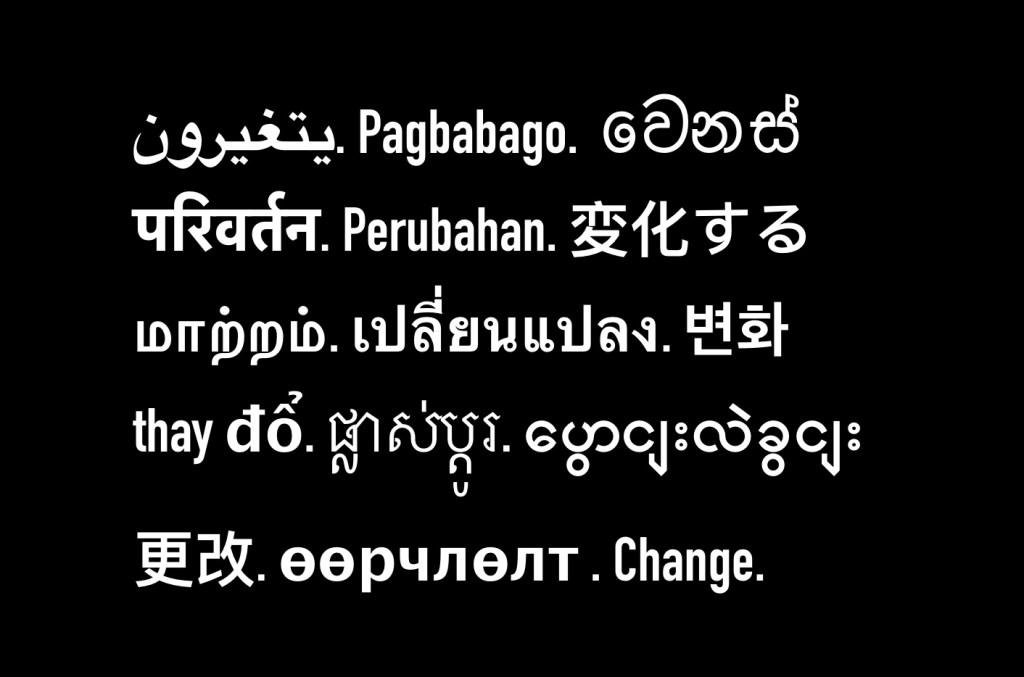
Why Do You Need to Translate Change Messages into Local Languages in Asia Pacific?
Touching the Hearts and Minds of Your Local Company Staff
Amongst all of the localisation requirements, translation of the main content is the most important. If you spend all your energies in localising the key visuals for the posters and developing fancy taglines into your local language but kept the actual change messages in English, you would have definitely “missed the forest for the trees”.
That is the reason that we will have to dive deeper into the important task of translation which at surface level might seem simple and straightforward but in real life is not. And if you take time to think about it, everything else being equal, a well-localised change message in one’s own native tongue is the first step in reaching someone’s heart and mind.
In fact, delivering your change communication in local languages is the most important step in localising your messages for your audience. Do not compromise on this. Even if you get the axe for the budget for all other localisations, please fight for this because this is the “cake” (core) in customization.
While there is no research that your target audience would accept a change message in their local languages more readily than, say if it were in English, you would agree that they would definitely understand it much clearly and much faster. Also, it would definitely reduce some of the misunderstandings that normally surrounds communicating in English to non-native English speakers.
How Do You Take Care of the Translation Work Package?
Its a common myth that anyone who speaks and writes in two languages will be able to be a translator or an interpreter. For sure yes, for basic day-to-day conversations but not for business communication with an agenda to change people. The last thing you want in your hands is a poorly translated or, even worst, misleading change messages going to your target audience causing mayhem.
Therefore please handle the translation work package in a professional way. This means hiring a professional translator with proven experience in your industry. This proven experience ensures that he/she will use the right terms and technical words in the communication.
Translating Using an Agency
This may be also one of the services which a communication agency or a public relations or an advertising agency may offer you as part of the total package, assuming that you are hiring a lead agency for your change communication needs.
This is a great idea if the translator is good and fits your needs because it will offer you seamless coordination in production processes between what is being translated and how that is being used in mobile apps, campaign video clips and websites, for example.
However, for such possibilities, I would recommend making an estimation of the volume of translation required and to include this into the budgeting and sourcing process right at the beginning when looking for lead agencies.
Translating Using an Independent Translator
Please do not hire freelancers from the internet or use your friend’s friend who was educated in London or your neighbour’s wife who is a university lecturer in economics. I know it sounds funny but these things do happen in Asia because people always try to cut corners, but please – not this corner!
As I mentioned before, not everyone who is bilingual in English and another language can become a professional translator. And that is why there exists a professional translation and interpretation industry.
Another reason why you should not hire an independent or freelancing translator is for reliability reasons. There is no guarantee that you could be left hanging in the air if the translator falls sick or has some other urgent task or simply disappears into thin air.
But of course, there is no guarantee that this will not happen when working with an agency or a translation company but at least they will try to find solutions for you because they have a reputation to keep.
Translating Using In-house Resources
The other way is translating your change content in-house, which can be a very common and convenient option. However, this should be only attempted by people who truly have a high level of language proficiencies in both your local language as well as in English. I bite my tongue to say this, but it does not necessarily mean that all the people in your company’s Communication or Marketing Department can become good translators. Let me explain.
Beware: Not All Communication Professionals Make Good Translators
Communication professionals can be experts in a different communication area such as organising events, launching advertising campaigns or developing social media strategies but it does not mean that all of them will be good in a certain language or good in writing a letter according to professional corporate communication standards. There are 11 players on a football team and they are all called football players. But each one of them performs different functions such as goalkeeper, striker, defence etc. Surely a goalkeeper can play as a striker but I think he might really be good at it or even like it.
Here is an example. Imagine a communication manager in the state of Johore Bahru in Malaysia or in the city of Hangzhou in China could have been hired due to his/her experience in the industry, connections with the local media, suppliers and government and for his/her proficiency in Bahasa Malaysia or Putonghua (Chinese Mandarin). Not particularly because he/she is good in languages or in writing.
Best Practices and Key Takeaways
- Keep your entire change communication campaign in your local language because it immediately brings the change messages closer to your audience’s hearts and minds.
- Identify the volume of translation after the communication planning is completed and add this work package to the communication budget and the sourcing requirements.
- Being good in two languages does not make one a good translator for professional business communication. Please hire industry-grade professional translators with a proven track record,
- Make the transferring of the translated content seamless with all parties involved in the translation and production processes.
- Make sure you allocate sufficient resources and buffers for the translation work package else it will delay your change communication campaign.
- Please do a final review in-house with a few senior managers and get the management’s tick-in-the-box before circulation.
 For Those In-Charge of Change